


You've probably seen the ads: web hosting for $2 a month, unlimited everything, free domain included. For a small business watching every dollar, it's tempting.
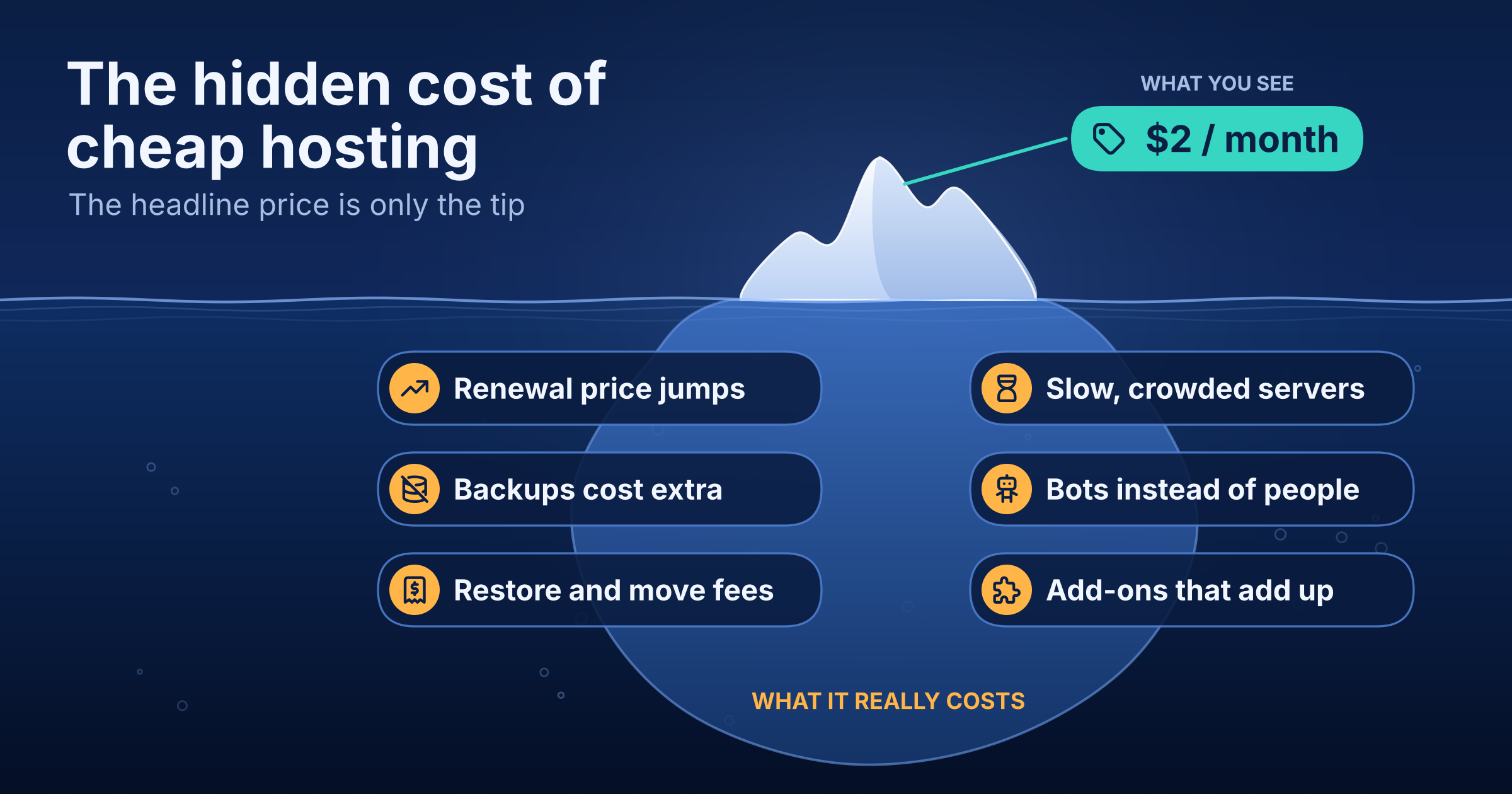
Sometimes it's a perfectly good deal. But often the headline price is just the entry fee, and the real cost shows up later as renewal bills, paid add-ons, slow pages, or a lost weekend trying to get your site back online.
Here's what cheap hosting tends to leave out, and how to compare hosts on what actually matters.
1. The price you see isn't the price you pay
The cheapest plans are usually priced to get you in the door. Look closely and you'll often find:
- Introductory pricing. The advertised rate applies only to your first term. At renewal, the price can jump to two, three or even four times as much.
- Long upfront commitments. That low monthly figure often requires you to prepay two or three years in advance. Pay month to month and the rate is much higher.
- "Free" domains that aren't free for long. The first year costs nothing, but the renewal price is often well above what you'd pay elsewhere, and moving the domain later adds hassle.
- Prices that leave out GST or use another currency. A price in US dollars, or one that doesn't mention GST, can look cheaper than it really is for a New Zealand business.
Tip: Always ask "what will I pay at renewal?" That's the number that matters for the life of your website.
2. Backups are often missing or extra
This is the one that hurts most, because you don't find out until it's too late.
On many budget plans, backups are:
- not included at all
- a paid add-on
- kept for only a few days
- stored on the same server as your website, so a server failure takes out both
- available, but restoring one costs a "recovery fee"
Your website and email represent years of work. If a plugin update breaks your site, someone deletes the wrong folder, or your site gets hacked, a recent backup is the difference between a 10-minute fix and starting over.
Tip: Ask how often backups run, how long they're kept, where they're stored, and whether restoring one costs extra.
3. Support that isn't really support
When something goes wrong, the quality of your host's support suddenly becomes the most important part of the deal.
Budget hosts keep prices low by keeping support costs low. In practice, that can look like:
- chat bots and scripted answers instead of people who can actually fix things
- long queues, or support only during business hours in another time zone
- "that's outside our scope" when the problem involves your website rather than the server
- upsells offered as the fix, such as "you need our premium plan for that"
Ten dollars a month saved on hosting disappears quickly when your site is down for a day and nobody can tell you why.
Tip: Test support before you buy. Send a pre-sales question and see how quickly a real person replies, and whether the answer is actually helpful.
4. "Unlimited" usually has limits
"Unlimited storage" and "unlimited bandwidth" sound great, but every server has finite resources. Cheap plans usually manage that through:
- Fair use clauses that let the host throttle or suspend your site if you use "too much"
- Hidden caps on files (inodes), database size, email accounts, or CPU and memory use
- Crowded servers packed with thousands of other sites, so a busy neighbour slows yours down too
The result is a site that feels fine when you test it at midnight but crawls at 10am on a Monday, right when your customers are visiting.
Tip: Look past the "unlimited" label for the actual resource limits, and read the acceptable use or fair use policy.
5. The add-ons add up
Things you might assume are included can turn out to be extras:
- SSL certificates (the padlock in the browser)
- daily backups and restores
- email accounts or extra mailbox storage
- malware scanning or cleanup
- site migration from your old host
- a dedicated IP, staging sites or developer tools
Each one is small on its own. Together they can turn a $2 plan into a $20 plan, without the quality of one.
6. Slow pages cost you customers
Cheap plans are often hosted overseas on crowded hardware. Both of those affect how quickly your pages load for New Zealand visitors.
Speed isn't just about convenience. Slow sites tend to rank lower in search results, lose visitors before the page finishes loading, and convert fewer of the visitors who do stay. If your website brings in leads or sales, a slow host costs you money every day, even though it never shows up on an invoice.
How to compare hosts fairly
Before you sign up anywhere, run through this checklist:
| Question | Why it matters |
|---|---|
| What's the renewal price, including GST, in NZD? | Shows the real long-term cost, not the teaser rate |
| Do I have to prepay years in advance for that price? | Shows the real monthly cost |
| Are backups included? How often, how long are they kept, and where? | Protects you when something goes wrong |
| Is restoring a backup free? | Avoids surprise recovery fees |
| Is SSL included and set up automatically? | Every site needs it now |
| Who answers support, and when? | Tells you whether you can get real help at 9am Monday or 9pm Saturday |
| Where are the servers? | Affects speed for your customers and where your data lives |
| What are the actual resource limits? | "Unlimited" rarely means unlimited |
| Is there a money-back guarantee? | Lets you test before you're locked in |
| How easy is it to leave? | A good host doesn't need to trap you |
Add up the total cost over two or three years, including the add-ons you'll actually need, and compare that. The cheapest headline price often isn't the cheapest host.
Where Hoopla Hosting stands
We'll be upfront: we're not the cheapest host you'll find, and we don't try to be. We'd rather give you a plan that does what it says on the tin. Every Hoopla cPanel plan includes:
- Free SSL that's set up and renewed automatically
- Automated backups, plus daily off-site backups and the option to download your own copy any time
- 24/7 support from a local team, by ticket or on 0800 466 752
- Servers in Auckland and Sydney that we own and manage ourselves
- A 30-day money-back guarantee on hosting, so you can try us risk-free
If you'd like a second opinion on what you're paying now, or what you actually need, send us a message. We'll give you a straight answer.
The bottom line
Cheap hosting isn't always bad, but the price on the ad is rarely the whole story. Look past the headline price, ask the questions above, and compare the full cost over the life of your website. The right host is the one that's still good value when something goes wrong.